USGS Investigators: Paul Bradley , Kelly Smalling
NPS Investigators: Matt Kulp , Brian Roberts
| 2026 | 2027 |
|---|---|
| $75,000 | $75,000 |
NPS Park: Great Smoky Mountains NP
USGS Center: South Atlantic Water Science Center New Jersey Water Science Center
States: Tennessee
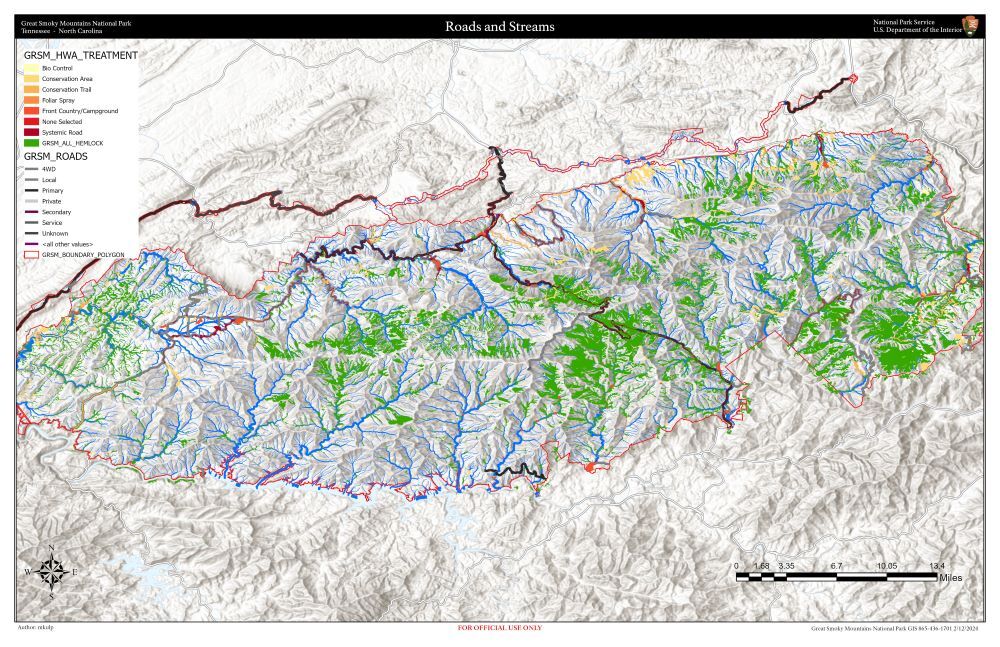
Invasive hemlock woolly adelgid (HWA) outbreaks are currently devastating Eastern (Tsuga canadensis) and Carolina (T. carolinana) Hemlock stands throughout eastern North America, including the more than 365 km2 of old-growth (some over 500 yrs) and younger hemlock stands within Great Smoky Mountains National Park (GRSM). To manage this threat to the park’s ecosystems, GRSM has applied the neonicotinoid insecticide, imidacloprid, since 2002 on a rotating basis in various stream drainages throughout the park, treating more than 33 thousand trees annually. A 2019 USGS-NPS Water Quality Partnership Program spatial-reconnaissance study designed to inform in-stream exposures to contaminants of emerging concern, including pesticides, assessed 16 GRSM stream sites and detected imidacloprid in half of the sites at levels of concern for stream invertebrate communities.
GRSM managers continually seek to balance the need for aggressive Hemlock-protective treatments with protection of non-target species, including aquatic species in streams throughout the park. The objective of this study is to provide a more comprehensive, spatial and temporal assessment targeted specifically at streams within historical and ongoing HWA-treatment basins to better characterize in-stream imidacloprid exposures and inform adjusted or additional biological/chemical HWA-treatment approaches to minimize impacts to aquatic resource. This study will evaluate in-stream imidacloprid exposures two times per year in 30 streams across the park for a period of 2 years. The results of this study also can be applied to other NPS parks impacted by invasive HWA outbreaks.