USGS Investigators: Paul Bradley , Kelly Smalling
NPS Investigators: Matt Kulp , Brian Roberts
| 2026 |
|---|
| $50,000 |
NPS Park: Great Smoky Mountains NP
USGS Center: South Atlantic Water Science Center New Jersey Water Science Center
States: Tennessee
Great Smoky Mountains National Park (GRSM), is considered America’s most biologically diverse National Park, is within a day’s drive of more than half of the U.S. population and is the most visited park boasting over 13 million visitors each year. High vehicle visitation parks, like GRSM, offer a unique opportunity to assess the potential for aquatic exposures and adverse effects of tire wear particles in areas where roads intersect ecologically important headwater streams. During normal driving conditions tire wear particles are shed from tires and deposited onto roadways. 6-p-phenylenediamine; N-(1,3-Dimethylbutyl)-N’-phenyl-p-phenylenediamine (6PPD) is an anti-degradant that has been used in tires since the 1960s and is vital for preventing catastrophic tire failure. It’s ozonated transformation product 6PPD-quinone (6PPDQ) can be acutely toxic to sensitive fish species including brook trout and is widely observed in streams near road crossing following rain events.
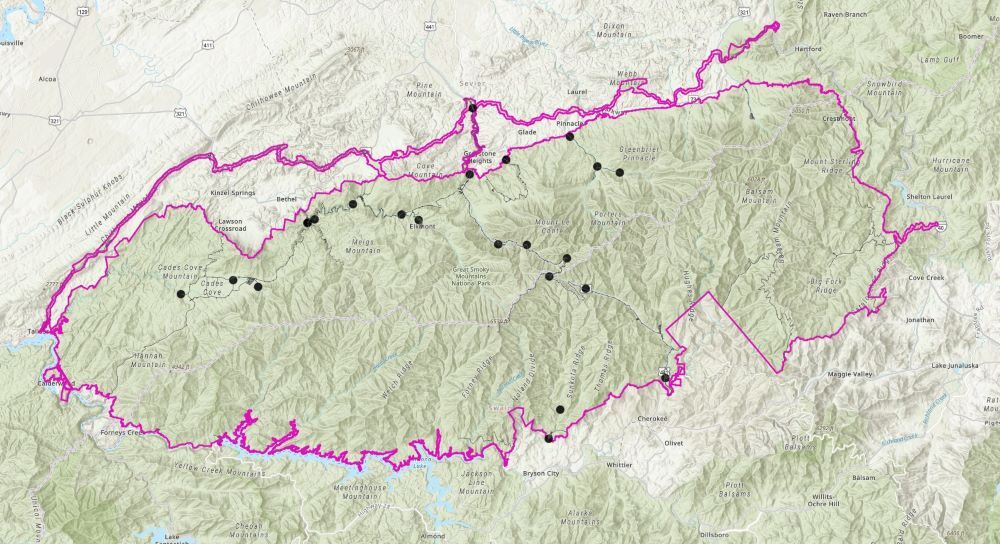
Information on 6PPDQ in national parks is nonexistent and to address this gap, the current project is designed as an initial assessment of local stream reaches at various times of the year to determine if 6PPDQ is a potential threat to aquatic species, like brook trout. Because in-stream 6PPDQ exposures are generally transient, with the highest concentrations and often effects occurring during runoff events, it is notoriously difficult to link to lethal events. For this reason, spatial and temporal data on 6PPDQ occurrence in selected stream reaches is essential for the management and conservation of brook trout and other aquatic species in GRSM. Up to 18 sites selected by park staff near road stream crossings will be sampled multiple times per year to capture episodic pulses of 6PPDQ. To account for multiple potential exposure routes to fish and other aquatic organisms, both surface waters and stream sediments will be analyzed. The initial results of this project will provide park managers and staff with scientific data on the potential occurrence, distribution, and impact of 6PPDQ. This type of study can also be further expanded to other parks with high intensity road traffic and can be used by Park managers to improve the management of road runoff thereby reducing exposure and potential effects.